The Shift Toward U.S. Privacy-Compliant Tracking: Why Businesses Need a Modern, Opt-Out-Ready Analytics Framework in 2026
U.S. Privacy Has Outgrown Legacy Tracking: What Changed?
U.S. Privacy-Compliant Tracking is becoming essential as state laws evolve in 2026. During the last 24 months we have seen the U.S. privacy landscape accelerate more than in the previous decade. With CPRA, CPA, CTDPA, VCDPA, MODPA, TDPSA, and additional state regulations taking effect or gaining enforcement maturity in 2026, businesses can no longer rely on 2018-era analytics stacks. According to the California Privacy Protection Agency, enforcement activity continues to expand. Ensuring U.S. Privacy-Compliant Tracking is at the forefront of business strategies is crucial.
Modern U.S. Privacy-Compliant Tracking requires enforcing opt-out states across every analytics and advertising platform. Regulators expect consent-aware, opt-out-enforced, privacy-governed data flows. Marketing teams expect stable attribution despite compliance constraints. Traditional setups meet neither requirement.
Moreover, the need for effective U.S. Privacy-Compliant Tracking grows as customer expectations shift toward transparency and control over their data.
The Core Technical Problem: Your Analytics Must Enforce Opt-Out Behavior
Most websites still treat privacy as a banner pop-up — not an architectural requirement. But U.S. state laws demand real technical enforcement, including stopping or modifying:
- Behavioral advertising signals
- Cross-context identifiers
- Third-party sharing
- Sensitive event types
- Downstream data transfers
A user’s opt-out preference must immediately influence:
- Server-side pipelines
- GA4
- Google Ads
- Meta (CAPI/Web)
- CRM ingestion
Why Most Implementations Fail
Because they rely on:
- Scattered client-side scripts
- Pixel tags firing before consent states resolve
- Retargeting identifiers leaking by accident
- No centralized governance layer
- Inconsistent logic across platforms
The result is a stack that is neither compliant nor reliable for measurement.
Introducing Trackture’s U.S. Privacy Engine™
Powered by Opt-Out Mode™ — Trackture’s U.S. State Privacy Tracking Framework
Trackture built this framework to solve the biggest challenge U.S. companies face in 2026:
How do you stay fully compliant without destroying attribution, optimization, or revenue performance?
Most agencies respond to privacy requirements by disabling tracking.
Trackture responds by engineering compliant tracking that still performs.
This is the fundamental difference.
What Makes Trackture’s Framework Different?
1. Compliance Tracking Layer Architecture (CTLA)
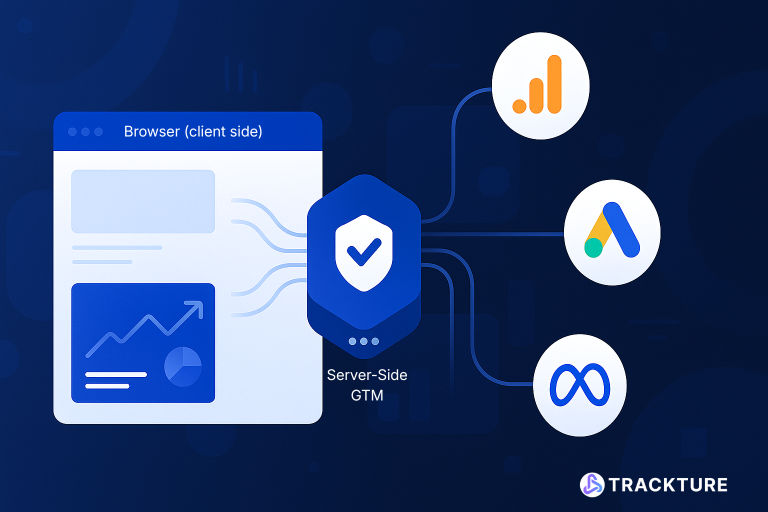
Without a structured U.S. Privacy-Compliant Tracking architecture, companies risk losing attribution accuracy as state laws tighten. CTLA is a dedicated enforcement layer sitting between:
User → Website/App → Tracking Infrastructure → Downstream Platforms
It ensures:
- Uniform privacy rules
- Centralized enforcement
- No identifier leakage
- Clean, compliant, reliable outputs
2. State-Specific Privacy Logic Built Into the System
Every state defines “sale,” “sharing,” or “targeted advertising” differently.
CTLA interprets these distinctions and enforces them automatically.
3. Opt-Out Mode™: The Enforcement Engine
When a user opts out, Opt-Out Mode™:
- Removes advertising identifiers
- Blocks sensitive events
- Switches to aggregated or modeled measurement
- Ensures no data is shared unlawfully
- Preserves performance through privacy-safe signals
4. Server-Side Tagging by Default
Legacy client-side tracking is noisy, leaky, and increasingly unreliable.
Trackture routes data through first-party, server-side infrastructure to maintain compliance and improve signal quality.
5. Cross-Platform Privacy Enforcement
CTLA ensures consistent behavior across:
- GA4
- Google Ads
- Meta
- CRMs
- Marketing automation systems
- Server-side pipelines
No more fragmented consent logic.
Why Businesses Need This Framework Now
The legal environment is tightening. Enforcement budgets are growing. Our framework solves the biggest challenge of U.S. Privacy-Compliant Tracking: ensuring measurement quality without violating user rights.
But the strategic reason is more important:
High-quality, privacy-safe signals now outperform non-compliant data.
Ad platforms reward:
- Server-side signals
- Stable event models
- High-quality first-party attribution
- Clean consent metadata
Poor-quality or restricted signals degrade:
- ROAS
- CAC
- Bid efficiency
- Optimization cycles
Privacy compliance is no longer a burden — it’s a competitive advantage.
Who Benefits Most From Modern, U.S. Privacy-Compliant Tracking?
1. Companies Operating in Multiple States
Fragmented privacy rules scale complexity exponentially.
2. Ecommerce & Subscription Businesses
Attribution quality directly impacts performance and profitability.
3. B2B SaaS & Lead Gen Companies
These companies must balance compliance with high-intent tracking needs.
4. Teams Struggling With Broken Consent Mode or Misconfigured CAPI Pipelines
Most setups are incorrect; Trackture corrects and rebuilds them with structure.
Privacy as Infrastructure: The New Competitive Frontier
Companies that embrace privacy-first engineering see gains in:
- Attribution accuracy
- Paid media performance
- User trust
- Cross-platform signal consistency
- Regulatory safety
Compliance is no longer documentation — it’s architecture.
Trackture designed its U.S. Privacy Engine™ to serve as that architecture.
Implementation: How Trackture Deploys This Architecture
Phase 1: Privacy-First Tracking Audit
A full CTLA readiness assessment:
- GTM & sGTM review
- GA4 configuration map
- Meta CAPI diagnostics
- Tag governance
- Platform sharing risk review
- State-level obligation analysis
Phase 2: U.S. Privacy Engine™ Deployment
Installation of:
- Server-side infrastructure
- CTLA enforcement
- State-specific rules
- Opt-Out Mode™
- Identifier minimization
- Platform integrations
Phase 3: Ongoing Compliance + Signal Optimization
Therefore, implementing U.S. Privacy-Compliant Tracking strategies will not only ensure compliance but also foster trust with users.
Trackture provides:
- Updates as laws evolve
- Enforcement drift monitoring
- Performance tuning
- Attribution stability improvements
Frequently Asked Questions
Is this only for California?
No. Multiple states now enforce opt-out requirements.
Does this replace our analytics tools?
No. It enhances and governs them.
Will compliance reduce performance?
Not with CTLA + server-side pipelines.
Most clients see performance improvements.
How long does implementation take?
Typically 3–6 weeks.
Final Thoughts: U.S. Privacy Compliance Is Now a Technical Infrastructure Problem
Most legacy analytics setups fail because they lack a unified approach to U.S. Privacy-Compliant Tracking across all U.S. states. Trackture’s U.S. Privacy Engine™ provides the foundation companies need to:
- Reduce regulatory risk
- Protect user rights
- Improve measurement
- Strengthen bidding signals
- Scale in a privacy-first era
Companies that modernize early will outperform those patching broken client-side setups or avoiding compliance altogether.
Learn how Trackture’s U.S. Privacy Engine™ solves this in practice with our U.S. Privacy-Compliant Tracking Service.
Unlock Accurate, Privacy-Safe Measurement Across All U.S. States
Your analytics infrastructure needs to be compliant, reliable, and built for the 2026 privacy landscape. Trackture’s U.S. Privacy Engine™ gives your team a future-proof, opt-out-ready measurement framework without sacrificing performance. Contact us a for consultation to learn more.