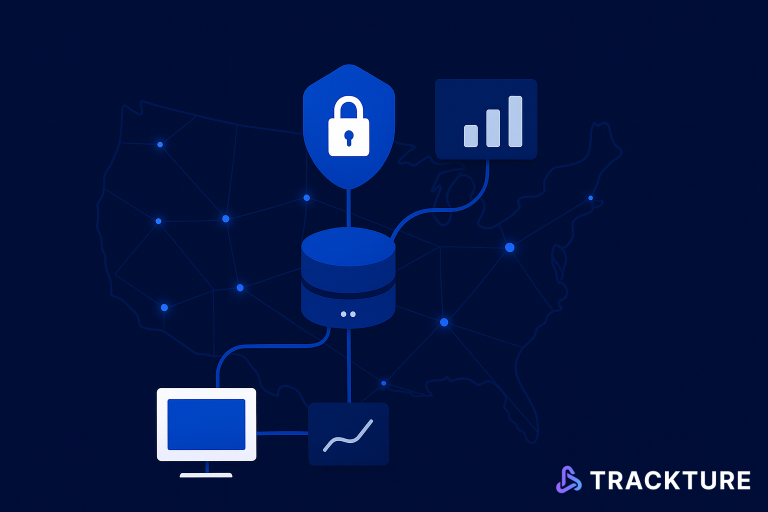

State-Level Privacy Laws Are Breaking Attribution | Privacy-First Architecture Explained
Executive Summary
U.S. state-level privacy laws are not just a compliance issue — they are breaking attribution by forcing marketing systems to process data differently by jurisdiction. Most tracking stacks are not designed for this. This article explains why state-level privacy is an attribution architecture problem and how privacy-first, jurisdiction-aware tracking preserves compliant measurement without sacrificing performance.
In this article, we explain why state-level privacy attribution is becoming a critical challenge for marketing teams operating across multiple U.S. jurisdictions. Most companies believe they are compliant with U.S. privacy laws. Many are not. And many that are compliant are quietly damaging attribution in the process.
The issue is not a lack of effort or intent. It is a fundamental misframing of the problem.
State-level privacy in the United States is not primarily a legal issue.
It is an attribution architecture issue.
Until tracking systems are designed to account for how privacy laws affect data processing — not just consent capture — marketing performance will continue to erode in subtle but costly ways.
What “Attribution Architecture” Means in a Privacy Context
Attribution architecture refers to how conversion data is collected, processed, routed, and shared across analytics and advertising platforms — including how those behaviors change based on jurisdiction and legal requirements.
In a privacy context, this means:
- How conversion events are handled after a user opts out
- How data is shared with ad platforms under different state laws
- How attribution and modeling are preserved while enforcing compliance
Most tracking stacks were not built with this level of conditional behavior in mind.
Why State-Level Privacy Attribution Is Breaking Marketing Measurement
U.S. privacy regulation is moving toward state-specific opt-out frameworks, not a single national standard.
These laws differ in:
- Scope
- Definitions of personal data
- Enforcement expectations
- Opt-out requirements
Crucially, they regulate data processing behavior, not just cookie usage.
This creates a challenge for marketing systems that assume:
- One national privacy logic
- One consent state
- One data flow
That assumption no longer holds.
How Attribution Breaks When Privacy Is Implemented Incorrectly
When privacy is handled as a surface-level control — banners, toggles, or basic consent flags — attribution does not fail immediately.
Instead, the failure is gradual and difficult to diagnose.
What breaks when attribution is not jurisdiction-aware:
- Conversion events are inconsistently processed across states
- Advertising platforms receive mixed or incomplete signals
- Attribution models degrade over time
- Performance becomes harder to explain and forecast
Nothing crashes. Nothing triggers an alert. Marketing teams simply lose confidence in the numbers they are expected to defend.
Why CMPs and Standard Consent Setups Are Not Enough
Consent Management Platforms are necessary.
They are also insufficient on their own.
CMPs:
- Capture user preferences
- Provide consent state visibility
They do not:
- Enforce state-specific data processing rules
- Control how conversion data is routed downstream
- Adapt tracking behavior dynamically by jurisdiction
A CMP can tell you what a user chose.
It does not decide how your tracking infrastructure behaves as a result.
That enforcement gap is where most organizations are exposed.
The Core Issue: Attribution Must Be Jurisdiction-Aware
If your tracking stack behaves the same way in California as it does in Texas, Florida, or New York, you do not have a state-level privacy strategy.
You have a one-size-fits-all system operating in a fragmented regulatory environment.
Modern privacy-first attribution requires:
- Jurisdiction awareness
- Conditional data handling
- Controlled data routing rather than blanket data loss
Privacy decisions must influence how data flows, not just whether tags fire.
The Architecture That Fixes It
Solving this problem does not require abandoning measurement. It requires treating privacy as infrastructure, not configuration.
Trackture Opt-Out Mode — Defined
Trackture Opt-Out Mode is a privacy-first tracking architecture that dynamically adjusts how data is processed and shared based on U.S. state-level opt-out requirements — without disabling attribution entirely.
At a high level, this architecture:
- Introduces a state-aware decision layer into the tracking stack
- Enforces opt-out laws at the data-processing level
- Preserves compliant attribution and modeled measurement
The goal is not maximum data collection. The goal is legally defensible, performance-grade data. Compliance without sacrificing attribution.
Why This Matters to Marketing Leadership
Marketing leaders are held accountable for performance metrics produced by systems they often do not control. Budgets, forecasts, and board-level decisions depend on attribution accuracy.
When privacy is bolted onto existing systems instead of engineered into them:
- Attribution becomes unreliable
- Platform learning degrades
- Performance volatility increases
Organizations that treat privacy as a marketing systems decision — not just a legal requirement — maintain cleaner data, stronger signals, and more stable performance.
Common Questions Marketing Leaders Are Asking
Does opt-out mean we lose all attribution?
No. When implemented architecturally, opt-out changes how data is processed — not whether attribution exists at all.
Are CMPs enough for U.S. privacy compliance?
No. CMPs capture preferences but do not enforce jurisdiction-aware data behavior.
Is this a legal issue or a marketing issue?
It is both. But attribution succeeds or fails inside marketing systems.
Privacy Is No Longer a Checkbox — It Is Architecture
State-level privacy enforcement will continue to expand. What is optional is whether compliance creates blind spots in your measurement.
Companies that redesign attribution architecture to be jurisdiction-aware will not only reduce risk — they will gain more reliable data, stronger performance signals, and clearer decision-making.
At Trackture, this is exactly what our Opt-Out Mode architecture is built to deliver: state-level privacy compliance without breaking attribution.
Learn how Trackture’s U.S. Privacy Engine™ solves this in practice with our U.S. Privacy-Compliant Tracking Service.
Interested in a tracking & compliance audit?
Trackture U.S. Privacy Engine™ reduces operational risk and simplifies compliance across your entire analytics and advertising ecosystem. If you would like us to analyze your existing tech-stack, the first step is to book a consultation with us.