
Trackture U.S. Privacy Engine™
Powered by Opt-Out Mode™ — The U.S. State Privacy Tracking Framework

Why U.S. Privacy Tracking Matters
U.S. privacy compliance is no longer a policy exercise — it is a tracking and analytics enforcement problem.
Trackture U.S. Privacy Engine™ is a standardized enforcement methodology for implementing and verifying state-level privacy requirements across your existing consent, analytics, and advertising infrastructure.
Nineteen U.S. states now regulate targeted advertising, data minimization, and opt-out rights. Each law introduces different enforcement triggers, timelines, and expectations. As enforcement increases, many organizations are discovering that legacy tracking setups continue to transmit data even after users opt out — despite having consent banners and updated policies in place.
Leadership teams don’t want to build an internal privacy engineering function or manage state-by-state tracking logic. They want a single, defensible enforcement approach that applies consistently across GA4, advertising platforms, and server-side systems — without sacrificing measurement integrity or operational clarity.
Trackture U.S. Privacy Engine™ delivers that consistency by designing, configuring, and verifying how opt-out rules are enforced across your analytics and advertising stack — replacing fragmented implementations with a unified, auditable enforcement framework.
What Trackture U.S. Privacy Engine™ Does
Trackture U.S. Privacy Engine™ standardizes how state-level opt-out requirements are implemented and enforced across your analytics and advertising stack.
Rather than relying on fragmented consent configurations or state-by-state workarounds, Trackture applies a single enforcement methodology — implemented through CMP configuration, Google Tag Manager logic, Consent Mode v2, and (where applicable) server-side routing — to ensure opt-out behavior is handled consistently for every user and every applicable state.
The result is predictable, verifiable tracking behavior that aligns privacy requirements with real-world analytics and advertising operations.
State-Level Opt-Out Enforcement
What it covers:
- Applies targeted advertising opt-out rules
- Detects and honors GPC signals
- Activates GA4 Restricted Data Processing
- Activates Google Ads Limited Data Use
- Suppresses remarketing identifiers
- Applies event-level suppression rules in sGTM
Unified Tracking Governance
What it covers:
- A single logic layer across 19 U.S. privacy laws
- No need for state-by-state configurations
- Standardized analytics behavior regardless of location
- Consistent handling for GA4, Ads, and server-side flows
- First-party preference state (no third-party cookies)
- Future-proof enforcement as new states are added
Server-Side Compliance
What it covers:
- Centralized rules inside sGTM
- Event rewriting + data minimization
- Automatic suppression of non-compliant traffic
- Architecture independent of client-side blockers
- Full visibility via debug mode
- Foundational layer for scalable compliance
Where It Applies
Trackture U.S. Privacy Engine™ applies a unified enforcement model across every active and enacted U.S. state privacy law. Rather than building separate logic for each jurisdiction, your analytics stack uses a single framework that automatically applies the correct state-level requirements. This framework ensures consistent U.S. privacy tracking coverage across all 19 supported states.
Coverage includes:
- California (CCPA / CPRA)
- Colorado (CPA)
- Connecticut (CTDPA)
- Delaware (DPDPA)
- Florida (FDBR)
- Indiana (ICDPA)
- Iowa (ICDPA)
- Kentucky (KCDPA)
- Maryland (MODPA)
- Minnesota (MNCDPA)
- Montana (MCDPA)
- Nebraska (NEDPA)
- New Hampshire (NHPA)
- New Jersey (NJDPA)
- Oregon (OCPA)
- Rhode Island (RI-DTPPA)
- Tennessee (TIPA)
- Texas (TDPSA)
- Utah (UCPA)
- Virginia (VCDPA)
One system. One ruleset. Every state.
Trackture U.S. Privacy Engine™ is designed to eliminate fragmentation and future-proof your privacy enforcement model long-term.
- No separate implementations
- No per-state code paths
- No legal guesswork for your team
- Consistent compliance across your entire tracking infrastructure
- Automatically extensible as new states pass legislation
- Learn more about the Global Privacy Control standard at https://globalprivacycontrol.org/.
EU Consent Mode vs U.S. Opt-Out Mode
EU and U.S. privacy laws follow two different enforcement models. Many companies try to repurpose Consent Mode v2 for the U.S., which leads to non-compliant behavior and inconsistent tracking. The Trackture U.S. Privacy Engine™ implements the correct opt-out model required by U.S. state laws—without a CMP and without disrupting your analytics stack.
EU (GDPR / Consent Mode v2)
Model: Opt-In
Key Characteristics:
- Tracking requires active user consent
- CMP required (consent banner + storage)
- Consent Mode v2 modifies GA4/Ads behavior based on consent states
- Ads personalization disabled until consent is granted
- No legal recognition of U.S.-style opt-out rights
Result: A front-end, consent-driven model built for GDPR—not U.S. state laws.
U.S. (State Laws / Opt-Out Mode™)
Model: Opt-Out
Key Characteristics:
- Tracking allowed by default until user opts out
- Required enforcement of GPC (CA, CO, CT, MT)
- Do Not Sell/Share and targeted advertising opt-outs
- Activates Restricted Data Processing (GA4)
- Activates Limited Data Use (Google Ads)
- Works without a CMP
- Server-side suppression logic applied in sGTM
Result: A backend-enforced model that handles targeted advertising rules, minimization, and data-restriction requirements across 19 states.
How Opt-Out Mode™ Works
Opt-Out Mode™ is the enforcement model behind Trackture U.S. Privacy Engine™. It evaluates user choices, browser signals, and state laws to apply the correct tracking behavior for every event. The result is a consistent, compliant data flow that scales across GA4, Google Ads, and all server-side endpoints.
1. User Opt-Out Interface
Users can opt out of targeted advertising, sale/share, and cross-context behavioral tracking through a lightweight first-party UI. Preferences persist without relying on third-party cookies.
2. GPC (Global Privacy Control) Detection
Opt-Out Mode™ automatically detects GPC signals and enforces them where required (CA, CO, CT, MT). GPC overrides all other UI inputs.
3. Event-Level Suppression
Every event is evaluated and processed based on jurisdiction and user preference. Depending on state rules, each event is:
- passed through normally
- passed with data minimization
- rewritten
- or fully suppressed
4. GA4 Restricted Data Processing (RDP)
When required, GA4 event payloads are flagged for Restricted Data Processing. This disables advertising features, personalization, and audience building.
5. Google Ads Limited Data Use (LDU)
Google Ads events are routed and flagged according to LDU requirements. Protected users are excluded from remarketing and personalized advertising flows.
6. First-Party Preference State
User choices are stored in a server-managed first-party state. This avoids reliance on CMP cookies or unstable client-side storage.
7. Server-Side Enforcement in sGTM
All compliance logic runs inside server-side Google Tag Manager, making enforcement resilient to client-side blockers while ensuring consistency across GA4, Ads, and future endpoints.
CTLA Architecture
The Compliance Tracking Layer Architecture (CTLA) is Trackture’s reference architecture for implementing privacy enforcement across analytics and advertising systems. Rather than a software component, CTLA defines how and where enforcement is implemented across your consent platform, Google Tag Manager, Consent Mode v2, and server-side routing. It standardizes how state-level opt-out rules, Global Privacy Control (GPC) signals, event suppression, and data minimization are configured, enforced, and verified before data is transmitted to GA4, Google Ads, or downstream endpoints.
CTLA provides a clear, auditable structure for enforcing privacy requirements consistently — without introducing new software into your stack.
System Architecture Diagram
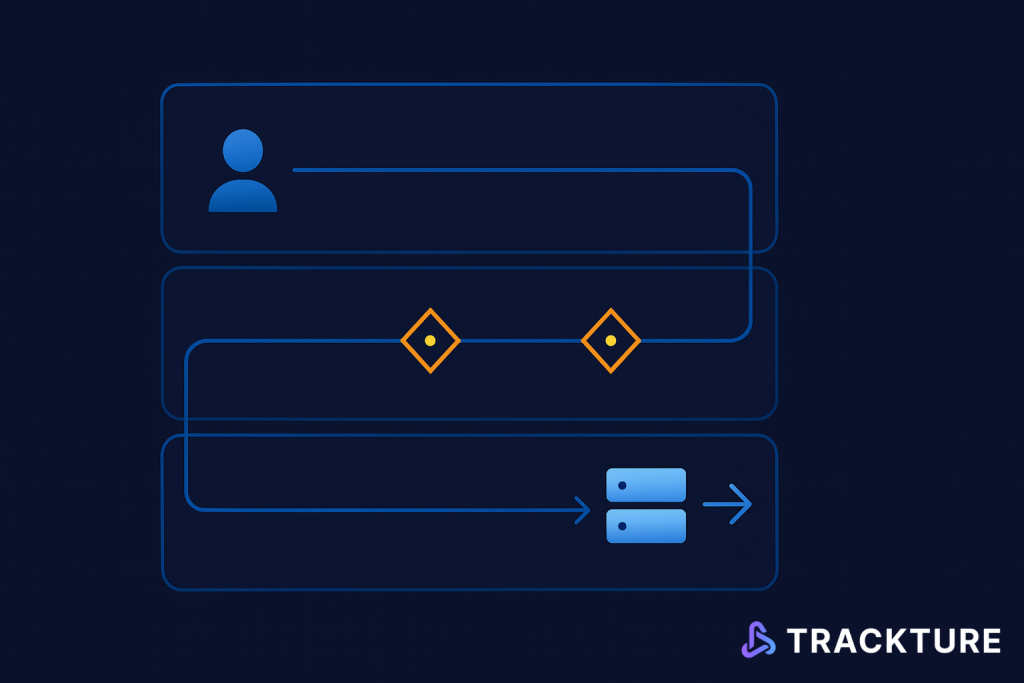
Frontend Layer
Captures user actions, preferences, and GPC signals. Sends events to the CTLA enforcement layer before any data reaches analytics or advertising endpoints.
CTLA Enforcement Layer
Applies state-level rules, opt-out logic, event suppression, data minimization, RDP/LDU activation, and routing logic inside a controlled, enforceable system.
Server-Side Tagging Layer
Executes final compliance logic in sGTM and forwards minimized, compliant data to GA4, Google Ads, and other downstream endpoints.
Deliverables
Trackture U.S. Privacy Engine™ includes a complete implementation package designed to operationalize U.S. state privacy requirements across your analytics and advertising systems. Every deliverable is engineered to ensure consistent enforcement, technical clarity, and long-term maintainability.
1. Opt-Out Mode™ UI Integration
Privacy-first frameworks integrated with your CMP, GTM, and data layer for GDPR/CCPA compliance.
2. GPC Enforcement
Automatic detection and enforcement of Global Privacy Control signals across supported states. GPC takes precedence over in-page preferences where required.
3. State-Based Suppression Logic
Event evaluation and routing rules applied within CTLA and sGTM. Handles suppression, minimization, rewriting, and fallback behavior consistently across all 19 states.
4. GA4 Restricted Data Processing
Configuration and activation of RDP for protected users, including minimization of analytics identifiers and blocking of personalized advertising signals.
5. Google Ads Limited Data Use
Automatic detection and enforcement of Global Privacy Control signals across supported states. GPC takes precedence over in-page preferences where required.
6. Documentation & Technical
Developer-ready documentation covering architecture diagrams, routing logic, state-by-state behavior, sGTM configuration, and QA procedures for ongoing governance.
Scope Clarifications
To maintain precision and avoid confusion, the items below fall outside the implementation scope of Trackture U.S. Privacy Engine™. These areas require your internal legal counsel or privacy team, and are not part of the technical enforcement layer Trackture provides.
The following responsibilities remain with your legal team:
- Legal interpretation or advice
- Privacy policy drafting or revisions
- State-mandated legal disclosures
- Children’s data compliance
- Sensitive data governance
- Vendor contract updates (DPAs, SCCs, etc.)
- Record-keeping, documentation, and regulatory filings
Benefits for Enterprise
Trackture U.S. Privacy Engine™ reduces operational risk and simplifies compliance across your entire analytics and advertising ecosystem. It replaces fragmented workflows with a unified enforcement layer designed for long-term scalability, governance, and executive oversight. Enterprises gain a unified, scalable approach to U.S. privacy tracking with reduced legal and operational overhead.
1. Reduced Legal Exposure
Automated enforcement of opt-out rules and GPC reduces the risk of non-compliant data flows across 19 state laws.
2. Consistent Analytics Behavior
A single logic layer ensures identical tracking behavior regardless of user location or state-level requirements.
3. No Internal Engineering Burden
Your team avoids building and maintaining complex state-based logic or sGTM routing rules.
4. Future-Proof Enforcement
As new states enact privacy laws, the engine expands without requiring redevelopment or infrastructure changes.
5. Strengthened Customer Trust
Transparent data handling reinforces brand integrity, especially for companies in regulated or consumer-sensitive sectors.
6. Scalable Foundation for First-Party Data
Creates a trustworthy data environment that supports clean reporting, remarketing exclusions, and privacy-aligned growth.
Use Cases
Trackture U.S. Privacy Engine™ is built for companies operating in multiple U.S. states, using GA4, Google Ads, or server-side tagging, and who need a scalable way to enforce privacy requirements without adding engineering burden.
GA4 + Google Ads Deployments
Organizations relying on Google’s analytics and advertising stack who need compliant data flows.
Companies Using Remarketing
Businesses running retargeting or audience-based advertising who need proper state-based restrictions.
Multi-State Operators
Brands selling or operating across several states with active privacy laws.
SaaS Platforms
Subscription products that collect behavioral and event data across U.S. users.
Server-Side Tagging (sGTM) Adopters
Teams moving toward first-party, server-side infrastructure and requiring compliant enforcement logic.
Retail, Healthcare-Lite, Finance-Lite
Any business with elevated expectations around privacy and user trust but without heavy HIPAA/GLBA classification.