

U.S. State Privacy Laws 2026: Maryland & New Jersey Enforcement Deadlines for Analytics
US state privacy laws 2026 are entering active enforcement, with Maryland and New Jersey representing the most immediate compliance risk for analytics and tracking systems.
What began as a wave of state-level privacy legislation is now transitioning into active enforcement, with direct consequences for how analytics, tracking, and advertising systems operate across the United States.
As of early 2026, 20 U.S. states have comprehensive privacy laws in effect. However, the most important dates for organizations are no longer when these laws were passed or technically “effective” — but when enforcement begins.
For analytics, tracking, and marketing infrastructure, enforcement dates are where theoretical compliance risk becomes legally actionable exposure.
Two enforcement deadlines in particular now define the risk landscape for 2026:
- Maryland (MODPA): Enforcement begins April 1, 2026
- New Jersey (NJDPA): Enforcement begins July 15, 2026
Organizations that continue to operate uniform, one-size-fits-all analytics configurations across all U.S. states are increasingly exposed once these enforcement windows open.for how privacy laws affect data processing — not just consent capture — marketing performance will continue to erode in subtle but costly ways.
Why Enforcement Dates Matter More Than “Effective” Dates
Many organizations track when a privacy law goes into effect. Far fewer track when non-compliant data processing becomes enforceable. This distinction is critical.
In practice, enforcement triggers scrutiny of:
- When tracking technologies activate
- What data is collected before consent is established
- Whether opt-out signals are enforced across all vendors
- How data minimization is implemented technically
- Whether analytics systems adapt to state-level requirements
Once enforcement begins, failures in these areas are no longer hypothetical. They are reviewable, auditable, and actionable.
Maryland’s Online Data Privacy Act (MODPA) illustrates this shift clearly. You can read the official legislation here.
Although MODPA formally took effect in October 2025, enforcement of non-compliant data processing does not begin until April 1, 2026. From that date forward, analytics and tracking implementations that fail to meet Maryland’s requirements move into enforceable risk territory.
US State Privacy Laws 2026: Enforcement Timeline by State
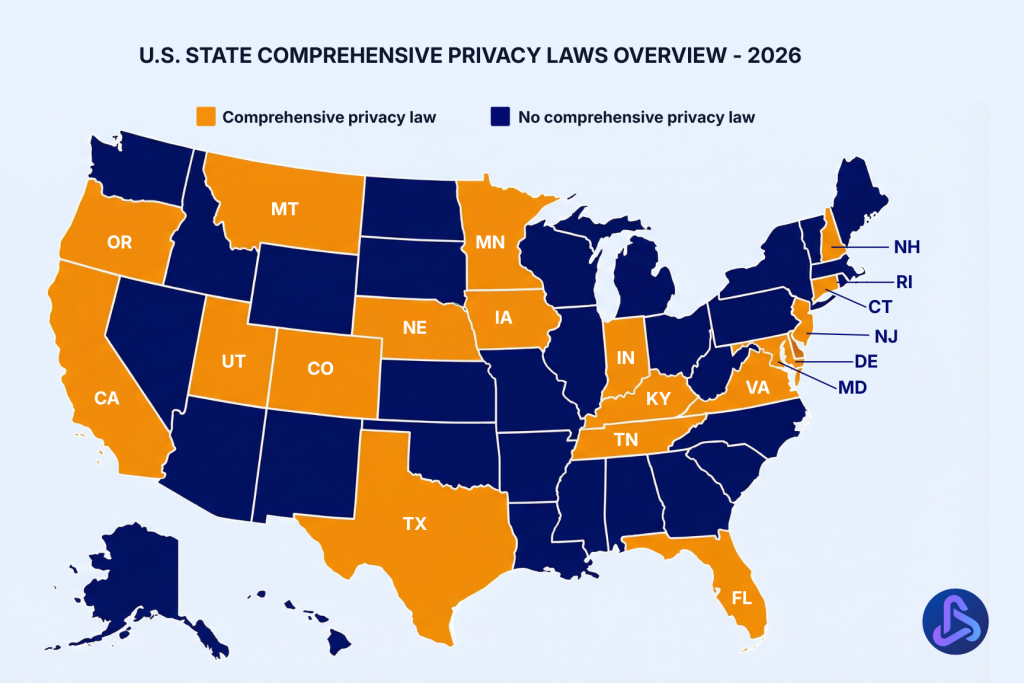
The table below focuses on enforcement relevance, not legislative passage dates. It highlights when compliance obligations are actively enforceable and where US State Privacy Laws 2026 risk is highest for analytics and tracking systems.
|
State |
Privacy Law |
Law Effective |
Enforcement Active |
Enforcement Risk Level (2026) |
|
California |
CCPA / CPRA |
Jan 1, 2020 / Jan 1, 2023 |
Active |
Medium |
|
Virginia |
VCDPA |
Jan 1, 2023 |
Active |
Medium |
|
Colorado |
CPA |
Jul 1, 2023 |
Active |
Medium |
|
Connecticut |
CTDPA |
Jul 1, 2023 |
Active |
Medium |
|
Utah |
UCPA |
Dec 31, 2023 |
Active |
Baseline |
|
Texas |
TDPSA |
Jul 1, 2024 |
Active |
Medium |
|
Florida |
FDBR |
Jul 1, 2024 |
Active |
Baseline |
|
Oregon |
OCPA |
Jul 1, 2024 |
Active |
Medium |
|
Montana |
MCDPA |
Oct 1, 2024 |
Active |
Baseline |
|
Delaware |
DPDPA |
Jan 1, 2025 |
Active |
Medium |
|
Iowa |
ICDPA |
Jan 1, 2025 |
Active |
Baseline |
|
New Hampshire |
NHPA |
Jan 1, 2025 |
Active |
Baseline |
|
New Jersey |
NJDPA |
Jan 15, 2025 |
Jul 15, 2026 |
High |
|
Tennessee |
TIPA |
Jul 1, 2025 |
Active |
Baseline |
|
Minnesota |
MNCDPA |
Jul 31, 2025 |
Active |
Medium |
|
Kentucky |
KCDPA |
Jan 1, 2026 |
Active |
Baseline |
|
Nebraska |
NEDPA |
Jan 1, 2025 |
Active |
Baseline |
|
Indiana |
ICDPA |
Jan 1, 2026 |
Active |
Baseline |
|
Rhode Island |
RI-DTPPA |
Jan 1, 2026 |
Active |
Baseline |
|
Maryland |
MODPA |
Oct 1, 2025 |
Apr 1, 2026 |
High |
Key takeaway:
Maryland and New Jersey represent the most acute enforcement risk in US State Privacy Laws 2026 due to strict statutory requirements combined with delayed enforcement windows that are now closing.
Why Maryland MODPA Changes the Compliance Conversation
MODPA is widely regarded as the most stringent U.S. state privacy law to date.
Unlike earlier statutes, Maryland’s law significantly raises the bar for lawful data processing, especially in analytics and advertising contexts. Key provisions include:
- Strict data minimization
Data collection must be limited to what is objectively necessary — not merely disclosed in a policy. - Enhanced sensitive data restrictions
Including biometric data, health data, and precise geolocation. - Expanded protections for minors
Including prohibitions on targeted advertising to known users under 18. - Algorithm and AI impact assessments
Required for processing activities deemed “high risk.”
For organizations operating national websites or digital advertising programs, this makes a single, static analytics configuration increasingly indefensible once enforcement begins.ose confidence in the numbers they are expected to defend.
Analytics Infrastructure Is Now the Enforcement Surface
Across regulatory guidance, enforcement actions, and litigation trends, the same operational questions continue to surface:
- When do tracking scripts and SDKs activate?
- What data is collected before consent is enforced?
- How are opt-out signals propagated downstream?
- Are inferred or derived data points being processed unnecessarily?
- Do analytics systems adapt dynamically to state-level requirements?
These are not policy questions. They are system-level implementation decisions — made inside tag managers, analytics platforms, CDPs, and server-side pipelines.
As US State Privacy Laws 2026 enforcement expands, organizations relying on client-side controls and uniform tracking logic face increasing compliance and defensibility risk.
What Organizations Should Be Evaluating Now
From an analytics and tracking perspective, risk mitigation in 2026 requires a shift in priorities:
- Inventory actual data flows
Document what systems actually collect and transmit — not what policies describe. - Validate consent enforcement technically
UI consent alone is insufficient if scripts fire before enforcement is applied downstream. - Assess state-level variance explicitly
Especially for outlier laws like Maryland’s MODPA and New Jersey’s NJDPA. - Audit third-party vendors
External tools are frequently the weakest link in compliance chains. - Move enforcement closer to the server
Client-side controls alone are increasingly inadequate for both compliance and audit defensibility.
Where Trackture Fits: Opt-Out Mode™ as Enforcement-Ready Infrastructure
As state-level enforcement accelerates, compliance is no longer achieved through banners, policies, or vendor assurances. It is achieved through architecture.
Trackture’s Opt-Out Mode™ is designed specifically for this enforcement reality:
- Jurisdiction-aware tracking logic
- Server-side enforcement of consent and opt-out signals
- State-level variance handling for analytics and advertising platforms
- Data minimization by design, not disclosure
- Defensible, auditable data flows under regulatory review
For marketing leaders, this removes the burden of interpreting 20+ state privacy laws at the implementation level.
For legal and privacy teams, it provides confidence that compliance is enforced where regulators actually look — inside the data pipeline.
As Maryland and New Jersey enter active enforcement in 2026, organizations that act now avoid last-minute retrofits under regulatory pressure — and gain long-term peace of mind that their analytics infrastructure is built for the privacy-first era.
Subscribe to Signal
Register with Trackture to never miss an update from Signal.